Date:
October 28, 2025

 BOOSTING CREATIVITY
Creativity doesn’t thrive in chaos — nor in control.
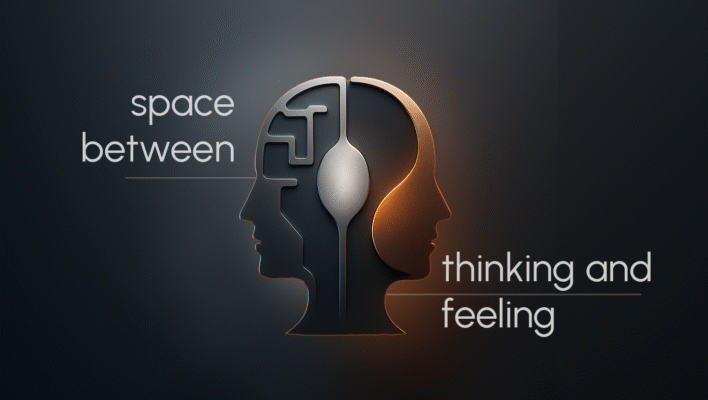
It lives in a quiet, balanced space between the two — where thought and feeling merge into awareness. This isn’t mysticism; it’s measurable, practicable, and deeply relevant in today’s noisy, reaction-driven world.
Most of us create from one of two ends — either too much thinking or too much feeling.
When we think too much, we judge too early. Every idea goes through a mental checklist of logic, ROI, and feasibility before it even breathes. When we feel too much, we drown in emotion — our work becomes impulsive, intense, and unsustainable.
Both are reactions, not creation.
The real creative act happens when the mind finds balance — a state where thought and emotion exist without overpowering each other. This middle space is not passive; it’s an active neutrality — awareness without judgment.
Modern neuroscience supports what artists and philosophers have intuited for centuries. Studies on mindfulness, attention, and creative cognition reveal that creativity peaks when the brain is neither hyper-focused nor distracted, but in a flexible, non-reactive state.
In essence, the less you force your mind to create, the more freely it does.
Neutrality isn’t laziness — it’s precision.
The “middle space” is not about suppressing thought or emotion — it’s about observing both without reacting.
Think of three mental modes:
Psychologists call this open monitoring — a state of awareness where you’re conscious of every idea but attached to none. It’s the same state musicians describe when they “disappear into the music,” or designers when “time stops during a build.”
This is not detachment. It’s involvement without chaos.
India’s work culture sits at an emotional crossroads.
In corporate India, thinking dominates — processes, data, and deadlines define creativity. In family-run businesses and creative fields, emotion dominates — decisions are made by gut, not frameworks.
Both mindsets are valid, but both are imbalanced.
Our education system rewards quick answers, not quiet reflection. Our workplaces applaud reaction, not observation. A manager who pauses before responding is seen as indecisive; a designer who questions a brief is seen as difficult.
This constant state of urgency and emotional overload breeds innovation fatigue.
We are mentally overstimulated, emotionally underprocessed, and creatively exhausted.
Observation: Across India’s startup and creative ecosystem — from coders in Bengaluru to illustrators in Baroda — the same pattern emerges: constant output, minimal reflection. We confuse activity with creativity.
That’s why the neutral state is not a luxury here — it’s a survival skill. It helps creators work from clarity, not compulsion.
Here are five proven methods (based on cognitive and behavioural research) to help you cultivate that middle space:
Before starting a creative task, sit still for ten minutes. Focus on your breath. When thoughts come, don’t push them away — observe them.
This practice is drawn from open-monitoring meditation, proven to enhance creative flexibility and emotional regulation.
Structure your work into three phases:
Create a physical reminder — a small stone, a sticky note, or a chime — that represents the “neutral zone.” Every time you touch or see it, pause for three deep breaths. Over time, your brain associates that signal with calm clarity.
Maintain a simple log:
“Was I thinking, feeling, or neutral?”
After each project, note when your best ideas came. You’ll start noticing that brilliance often appears during non-reactive, neutral states.
Your physical space mirrors your mental one.
Declutter your workspace. Reduce sensory noise. Work in silence for one hour daily. These micro-environments train your brain to enter neutrality faster.
A short, actionable experiment to help readers internalise the concept:
| Day | Practice | Objective |
|---|---|---|
| 1–2 | Observe your natural creative rhythm | Notice your default state — thinker or feeler? |
| 3–4 | Add 10-minute pauses before idea evaluation | Slow down judgment |
| 5–6 | Alternate between logical and emotional exercises | Find rhythm between modes |
| 7 | Reflect | What moments felt calm yet alive? Document your insight |
By Day 7, you’ll start recognising the feel of neutrality — it’s light, clear, and quietly powerful.
True creation doesn’t happen when you chase ideas or emotions — it happens when you let them meet.
The middle space is not silence; it’s alive awareness — where logic polishes emotion, and emotion humanises logic. It’s where great designers, writers, musicians, and entrepreneurs operate intuitively — with balance.
So, before your next creative sprint, pause. Observe. Feel. Think. Then, create from the middle.
Because the neutral mind isn’t empty —
It’s ready.