

Date:
April 22, 2026

 Uncategorized
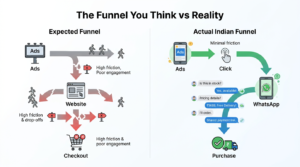
Most MSMEs believe their sales funnel looks like this:
Ads → Website → Conversion
Clean. Logical. Textbook.
But here’s what actually happens in India:
Ads → Click → Confusion → WhatsApp → Decision
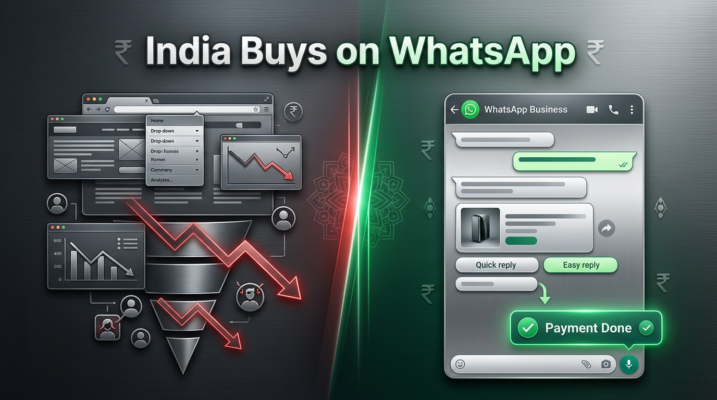
That gap between what you think is happening and what actually drives conversion is where your revenue is leaking.
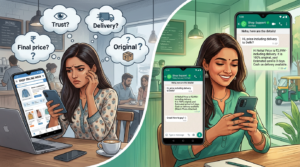
You’re optimizing landing pages, tweaking UI, running SEO—while your customer is opening WhatsApp to ask:
“Final price kya hai?”
“Delivery kab milega?”
“Original hai na?”
If your funnel doesn’t account for that behavior, it’s not a funnel. It’s friction.
Western funnels are built on self-serve confidence.
Indian funnels run on assisted trust.
That’s the difference.
In India:
This is why even after browsing your website, users still:
Your website might be perfect.
But behavior doesn’t care about your design.
Trust in India is built through interaction, not interface.
Let’s be blunt.
Most MSMEs are using WhatsApp badly.
Current usage looks like:
That’s not a sales system. That’s chaos.
WhatsApp is being treated as:
Instead of what it actually is:
A high-intent, high-conversion sales environment
By the time someone messages you on WhatsApp, they are already halfway to buying.
And you’re responding like they just walked in to browse.
This isn’t about websites being useless.
It’s about behavioural mismatch.
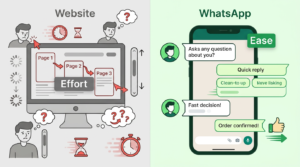
Users need to:
That’s work.
Users just:
That’s ease.
And that’s where conversion happens.
This doesn’t mean “kill your website.”
It means:
Stop treating your website as the conversion engine. Start treating it as a feeder into WhatsApp.
Your website should not try to answer everything.
It should push the right people into a conversation.
This is where most businesses fail—they don’t design the system.
Here’s what actually works:
Stop sending users to pages that make them think.
Send them where they can act.
Your entry points should include:
The goal is simple:
Reduce steps between interest and conversation
“Hi, how can I help you?” is a conversion killer.
Instead, your first response should:
Example:
This is not automation for convenience.
This is structured entry into a sales flow.
Not every message is a buyer.
Without qualification:
You need:
This step alone improves efficiency massively.
This is where money is made.
Inside WhatsApp, you should be able to:
The key difference:
You’re not presenting information—you’re guiding a decision.
Most MSMEs either:
Both are bad.
Instead, you need:
Example:
Follow-ups should feel like continuation, not interruption.
If your current system is:
You are leaving conversions on the table.
The businesses that win in India:
And all three happen best on WhatsApp.
Here’s the uncomfortable truth:
Most MSMEs invest in:
But ignore:
That’s why growth stalls.
You don’t need:
You need:
A system that converts intent into revenue
This is not about “setting up WhatsApp Business.”
This is about:
If your funnel still ends at your website, you’re playing an outdated game.
India didn’t slowly evolve into this behaviour.
It jumped straight into it.
And while you’re still fixing your homepage, your customer is waiting on WhatsApp.
The question is simple: Are you designing for how people actually buy—or how you think they should?