

Date:
April 22, 2026

 Business Strategy
Before companies had logos, people had tribes.
Every tribe had a rhythm — a shared belief that bound hunters, farmers, and artisans into something greater than themselves. Leadership in those tribes wasn’t defined by designations or pay grades; it was earned through service, sacrifice, and shared purpose.
Fast-forward to today’s corporate corridors. Titles have replaced trust. Strategy decks have replaced stories. Leaders chase quarterly targets while teams quietly crave belonging. Somewhere between the tribal fire and the boardroom, India’s work culture lost its soul.
A tribe wasn’t a structure; it was an emotion.

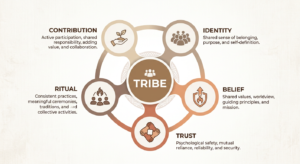
Its strength came from five invisible threads — identity, belief, trust, ritual, and contribution.
Identity – Everyone knew who they were and what they stood for. Belief – The tribe existed for something bigger than individual gain. Trust – Leadership was rooted in mutual respect, not control. Ritual – Collective habits built rhythm and resilience. Contribution – Every member mattered, and every role had dignity.
Tribal chiefs didn’t need appraisal systems to motivate their people. Their authority came from example. Their influence came from empathy. When a tribe thrived, it wasn’t because of management—it was because of meaning.
That’s the leadership India once understood instinctively: leading through connection, not command.
As industrialisation scaled, the human element shrank. Corporations adopted structures that optimised efficiency, not empathy.
Hierarchy became the new totem. Job titles replaced identity. Performance ratings replaced stories of contribution.
The result?
Employees execute but don’t belong. Leaders manage but rarely inspire. Vision statements sound good, but don’t feel true.
India’s corporate culture, while fast-evolving, often mirrors Western management systems that reward compliance over creativity. In contrast, tribal systems—like the Bhil, Gondi, or Khasi communities—functioned for centuries on cooperation and shared stewardship without formal hierarchies.
The irony? In chasing “modern leadership,” we’ve forgotten the most human kind.
Tribal wisdom isn’t primitive—it’s timeless.
Here’s what modern leaders can reclaim from it:
1. Build belonging before performance.
Before measuring productivity, create purpose. When employees feel seen and valued, performance follows naturally.
2. Lead by empathy, not entitlement.
A tribal chief eats last. Modern leaders must do the same—serve the team before self. Power is responsibility, not privilege.
3. Use stories and rituals to unite.
Tribes had fireside stories; corporates have town halls. Replace soulless presentations with narratives that remind people why they’re here.
4. Reward contribution, not compliance.
In a tribe, helping another member was currency. In corporations, small acts of collaboration should carry as much weight as KPIs.
5. Make culture your strategy.
Tribes didn’t write culture decks—they lived them daily. Culture is not a policy document; it’s behavior repeated with intention.
To bring back that sense of belonging, leaders can follow a five-step model — Identity → Shared Belief → Rituals → Contribution → Legacy.
1. Identity:
Define who you are as a team. Move beyond job roles — describe the tribe’s personality. What do you stand for?
2. Shared Belief:
Craft a belief everyone can rally behind. Not a slogan — a cause. “We design clarity,” “We make small businesses visible,” or “We protect what matters.”
3. Rituals:
Introduce consistent habits — Monday reflections, Thursday learning circles, Friday story hours. These small rhythms build emotional memory.
4. Contribution:
Empower everyone to own something. Give them autonomy to lead projects, propose ideas, or teach others. A tribe grows when every voice contributes.
5. Legacy:
Make people proud to say, “I was part of this.” Whether they stay or move on, let them carry your culture like a tattoo, not a payslip.
When startups and MSMEs in India embrace this model, they stop behaving like mini-corporates and start evolving as modern tribes — agile, bonded, and alive with shared energy.
Corporate India doesn’t need more managers. It needs more chiefs.
Leaders who listen before they speak. Who build circles, not pyramids. Who know that a tribe’s strength isn’t in its size, but in its sense of us.
The lost art of tribal leadership isn’t nostalgia—it’s necessity. As automation replaces tasks, what will keep teams together is trust, not targets.
The leaders who understand this will build not just profitable companies, but purposeful ones.
So maybe it’s time to put away the management manuals and light the fire again.
Because before we were employees — we were tribes.